Announcement
How Prava Pay lets people give AI agents like OpenClaw, Hermes, Claude Code, and Codex a safe way to pay.
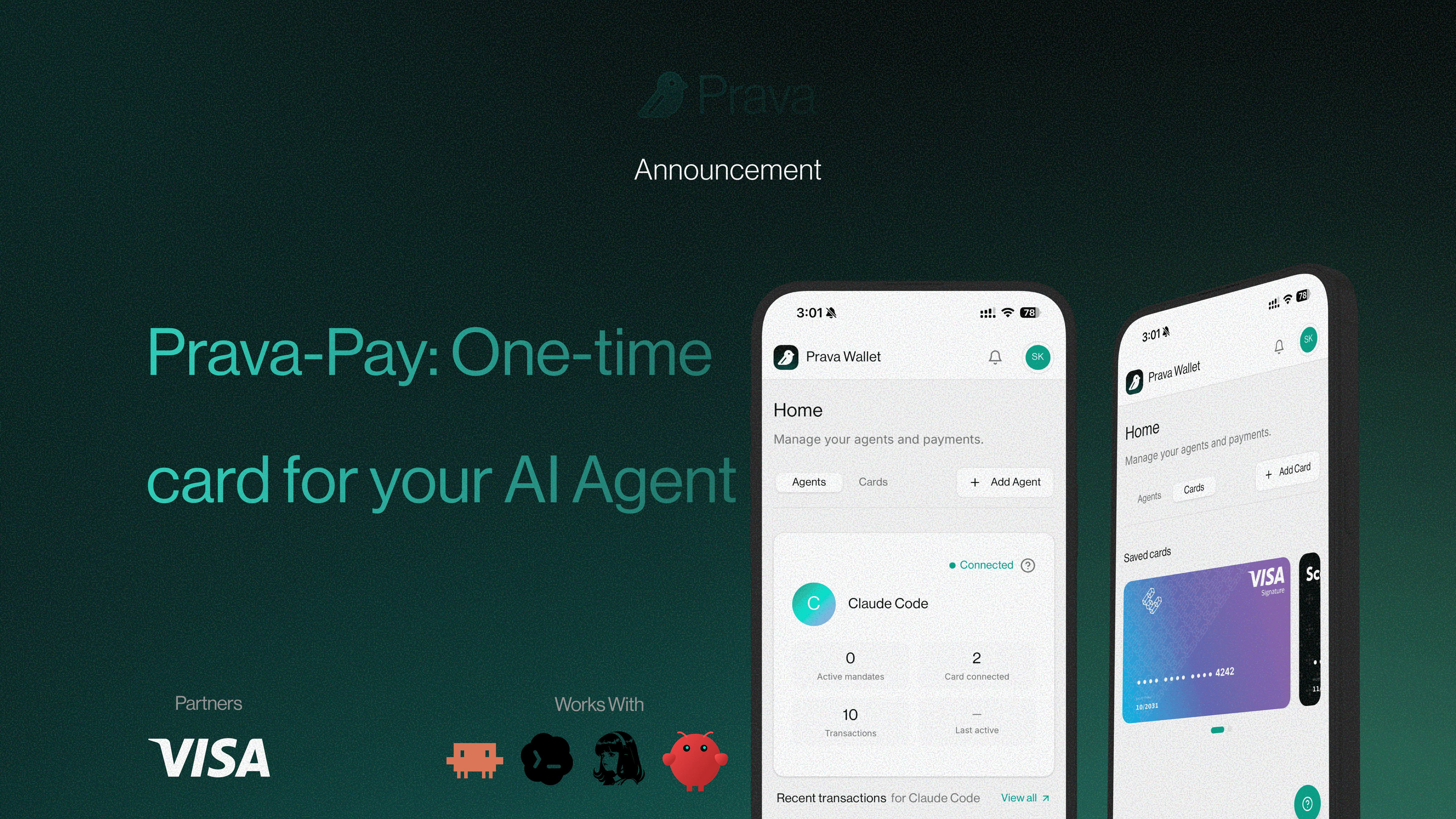
AI agents are starting to do real work, but they still break at the most important step: payment. An OpenClaw agent can find the right product, a Hermes agent can help plan a trip, and a coding agent can figure out that it needs an API credit or a software license. But once checkout appears, most agents still have to stop and hand the work back to the user.
Prava Pay is a card wallet for AI agents. A person can add their card to Prava Pay, connect an agent, and approve purchases as they come up. For every approved transaction, Prava Pay gives the agent a fresh one-time card scoped to that merchant, amount, and purchase. The agent can finish the checkout, but it never sees the user's real card and never receives open-ended spending access.
Why We Built It
Prava started as infrastructure. We built APIs and SDKs so developers could add agentic payments into their own products. If a company was building an AI shopping assistant, travel agent, procurement workflow, or vertical agent that needed to complete purchases, Prava gave them the payment layer to do it properly.
As developers started trying it, we kept hearing a different request. People were not only asking how to integrate Prava into a company product. They were asking how their own agents could pay. Someone using OpenClaw wanted their agent to buy something for them. Someone using Hermes wanted checkout to happen without handing over a card. Builders experimenting with personal agents wanted the payment layer, but they did not want to set up a company just to try it.
That exposed the gap in our first product. Infrastructure is built for businesses. It needs entities, KYB, compliance reviews, and all the things that should exist when a company is moving money through an API. That makes sense for platforms. It does not make sense for an individual who simply wants to give their agent a safe way to pay for a $40 purchase.
So we sat down with the Visa team and worked on the consumer version of the same idea. Instead of asking every user to become a developer customer, Prava Pay lets a person add their own card, authorize their own agents, and approve agent-initiated payments one by one. The result is a wallet that works for people using agents directly, not only for companies building agent products.
How It Works?
The user adds a card to Prava Pay and authorizes an agent such as OpenClaw, Hermes, Claude Code, or Codex. When the agent needs to buy something, it requests payment through Prava Pay. The user sees the merchant, amount, and purchase context, then approves the request with a passkey such as Face ID or Touch ID.
Once approved, Prava Pay creates a one-time card for that transaction. The card is scoped to the merchant and amount, so the agent can use it to finish the checkout but cannot reuse it somewhere else. The user's real card details stay inside Prava Pay, and the agent only receives the temporary credential required for that purchase.
Prava Pay also gives users basic controls around the agent. They can manage which agents are authorized, set limits, review transactions, and remove access. The goal is not to make an agent financially autonomous. The goal is to let it complete the purchase the user already approved.
Why This Is Not Just a Virtual Card
A normal virtual card is still a card number that may live across multiple purchases. It can be useful, but it also creates a new question: what else can the agent do with that card once it has it?
Prava Pay starts from the transaction instead of the card. The default is a fresh card for each approved purchase, scoped to the merchant and amount. This matters because agent payments are not only about convenience; they are about delegation. The user is not saying, "Here is my card." The user is saying, "You can complete this specific action."
That difference becomes important as agents move from recommendations to execution. If agents are going to book, buy, renew, subscribe, and pay on behalf of users, the payment layer has to carry the user's permission into the transaction itself.
What People Can Use It For
The useful use cases are not random purchases. They are situations where the agent already has enough context to decide what should happen, but still needs a safe way to complete the payment.
One category is agent-native checkout. An agent can help a user discover, compare, and buy from a merchant without dropping them into a manual checkout flow. This works best when the user has already given clear constraints: budget, merchant, delivery window, category, or preference.
Another category is multi-step purchasing. Travel is the obvious example because one request can involve flights, hotels, transport, events, and changes later in the trip. The agent can do more than recommend options if it can also pay inside the user's approved limits.
Developer workflows are also a natural fit. A coding agent may need API credits, a SaaS upgrade, a license, a test account, or access to a paid tool while building. With Prava Pay, the agent can request approval, complete the payment with a one-time card, and continue the work.
For operators and small teams, the pattern extends to procurement, supplier payments, subscriptions, research purchases, and other bounded business tasks. The common thread is not "let the agent spend." It is "let the agent finish a task after the user has approved the payment."
A Few Questions
Is Prava Pay prepaid?
No. Users do not top up a balance. They add a card to Prava Pay, and approved agent payments use fresh one-time card credentials.
Does the agent see the real card?
No. The agent receives a one-time card for the approved payment. The user's real card details are not exposed.
Can the agent spend without approval?
For normal purchases, the agent requests payment and the user approves it. Users can also set controls such as limits and manage which agents are authorized.
How is this different from a virtual card?
Prava Pay is transaction-first. Instead of giving the agent a standing card number, it gives the agent a fresh one-time card for an approved purchase, scoped to the merchant and amount.
Where is it available?
Prava Pay is available in the US for eligible Visa cards. Some card types are not supported yet, including Chase cards, prepaid cards, small business cards, and gift cards.
Try Prava Pay
You can get started at Prava Pay or install the wallet inside your agents chat.

Sushant
Founder